Great article by Simon Armitage in today’s Guardian about translating Sir Gawain and the Green Knight, one of my all-time favourite poems.
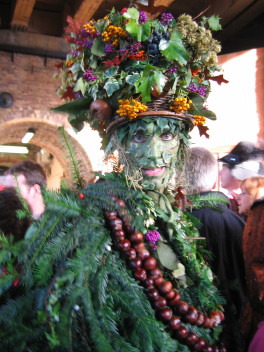
(courtesy of my wife’s blog)
I’m a bit of a purist when it comes to translating medieval poems – it’s not that hard to get through them with a gloss, and if you only read the translation you miss the poem itself. I’ve enjoyed the Tolkien and W.S. Merwin versions in the past, but to be honest I wasn’t that thrilled when I heard Armitage had done a new translation – do we really need another one? But I picked it up in Waterstone’s this week and found myself instantly captivated, almost against my will as I was supposed to be shopping for Christmas presents in other sections. I skipped to the first entrance of the Green Knight and my impression was that Armitage had done a great job of staying faithful to both the alliterative texture of the poem and the fastidious detailing of the Green Knight’s accoutrements.
So now I’m actually quite keen to give the rest of Armitage’s translation a go, and delighted to hear it will be read by Sir Ian McKellen on Radio 4 at 2.15pm on 21st December – make a note in the diary now!
The Guardian article begins with a funny description of Armitage trying to persuade the British Library to let him see the original manuscript. For commendably refusing to do the “Do you know who I am?” routine, he ends up being fobbed off with postcards from the Library shop. And he takes translatorly dedication further than most by going to watch a deer being butchered by a farmer, to help him translate the grisly hunting scene. Interesting to learn that the Gawain-poet’s description of the butchery was accurate enough for the farmer to recognise everything except the single word “numbles”.
Armitage gives a memorable description of his motivation in translating the poem. He comments that most of the lines in the medieval poem are on the brink of intelligibility for the modern reader:
They seem to make sense, though not quite. To the untrained eye, it is as if the poem is lying beneath a thin coat of ice, tantalisingly near yet frustratingly blurred. To a contemporary poet, one interested in narrative and form, and to a northerner who not only recognises plenty of the poem’s dialect but detects an echo of his own speech rhythms within the original, the urge to blow a little warm breath across that layer of frosting eventually proved irresistible.
Well he’s melted my reservations about another translation. When I listen to it next week it may well feel like the start of Christmas.
Article found via the wonderful The Page.

I think I understand your meaning when you write of “pure” poetry; rather, poetry in it’s purest form. That form, of course, must be the original. For example, it stands to reason that one could pursue a native fluency in Italian to read The Divine Comedy as Dante intended (we loose the
terza rima in English, and what other subtleties besides?). In lieu of a quasi-lingual audience, good translations are necessity for the rest of us.
As a fan of the Green Knight, as well as Sir Ian McKellen; this is exciting news!
Thanks Tim. I wasn’t really thinking of ‘pure poetry’ so much as me taking a possibly hardline stance on reading the originals, but I think we agree that much is Lost in Translation.
So if you haven’t seen it, you might be interested in my piece on Reading Basho’s Haiku in the Original. (I visited Basho’s birthplace last week, so it’s particularly topical for me!)
Well…my response is certainly untimely, but any chance to discuss this poem inevitably draws me in.
One of the many things I enjoy about the poem is how it sounds when read aloud. And as my mother was from Germany (near the confluence of the Rhine and Nahe rivers), and I grew up speaking German, the poem became easier to understand as I heard it.
I really do “love” this poem. I know, I know…we Americans use that phrase too frequently and in situations that are way out of context. But it has added so much to my life and for that I can’t thank the anonymous poet enough.
Armitage’s translation is pretty good…but I agree with you. It just sounds better in the original.
A few years ago I was lucky enough to hear Robert Wynne-Simmons recite the whole original text of Gawain and the Green Knight, it was an amazing experience. You can hear some of his recordings of shorter poems from the Gawain poet here